
And decades later, we are upholding the same.
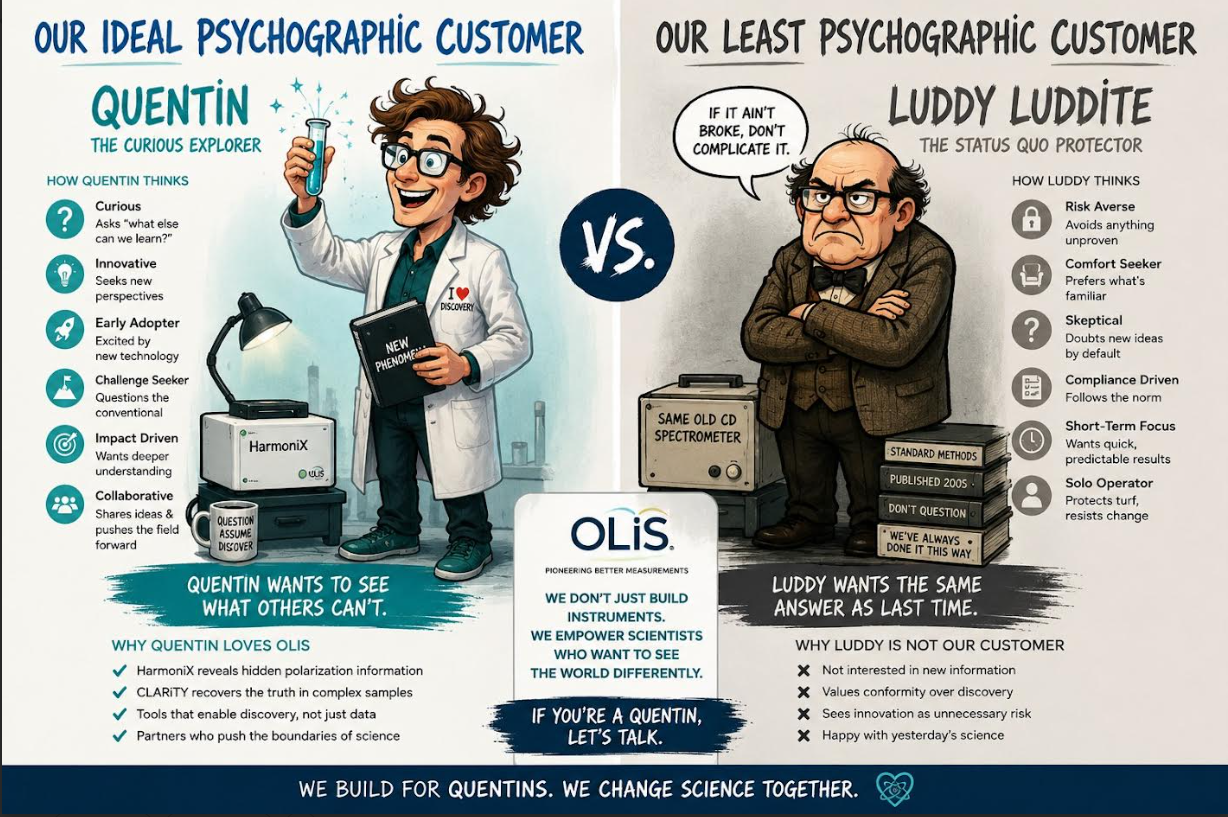
We chose the name “Quentin” as our avatar for Prof Quentin H. Gibson, a member of both the Royal Society and the U.S. National Academy of Sciences.
His experiments helped establish what is now textbook knowledge about how hemoglobin binds and releases oxygen.
And, in the era when researchers were using oscilloscopes, film, and manual data reduction, he and his then post-doctoral student, Richard J. DeSa, introduced computerized digital acquisition for stopped-flow spectroscopy. The work became the intellectual foundation that ultimately led to OLIS.
Both men spent their lives pursuing rigorous experimentation, careful interpretation of data, and a willingness to invent entirely new instrumentation when existing tools were inadequate.